When you're comparing replacement windows, the sticker can feel like a plate of alphabet soup. U-factor, SHGC, visible transmittance, air leakage. Most homeowners want to know one thing: which window will make the house more comfortable without wasting money? That's where U-factor vs SHGC explained in plain English helps. These two ratings tell you how a window handles heat, but they measure different problems.
I spent years installing windows in cold-climate homes around Minneapolis. I've seen a cheap-looking double-pane unit outperform a fancy window that was installed badly. I've also seen homeowners pay extra for a low U-factor when their real problem was summer overheating. The glass matters, but so does the house, the direction of the window, and the quality of the installation.
What U-factor measures
U-factor measures how quickly heat moves through a window. It includes the glass, frame, and spacers in the rated window unit. Lower is better. A window with a U-factor of 0.27 insulates better than one rated 0.32, just as a thicker winter coat keeps you warmer than a thin sweatshirt.
For a cold Midwest or Northeast house, U-factor deserves serious attention. Older double-pane windows often land around 0.45 to 0.60. Current energy-efficient replacement windows commonly fall between 0.25 and 0.32. Premium triple-pane products can reach roughly 0.20 to 0.24, though the frame and installation still determine how that performance feels in the room.
The difference shows up near the glass. A high-performing window feels less cold beside the couch, reduces condensation risk, and helps the furnace run less often. It doesn't turn a drafty wall into a perfect envelope, but it can remove a cold surface that makes a room uncomfortable.
If you're shopping in a cold climate, I usually start by comparing U-factor at or below 0.30. A lower number is useful, but don't spend an extra $250 per opening just to move from 0.27 to 0.24 unless the window is large, the room is used constantly, or you're already paying for triple-pane glass.

What SHGC measures
SHGC stands for solar heat gain coefficient. It measures how much sunlight enters through the window and becomes heat inside the house. The number runs from 0 to 1. Lower SHGC blocks more solar heat. Higher SHGC lets more solar heat enter.
This is the part many cold-weather homeowners overlook. A south-facing window can collect useful warmth on a sunny January afternoon, so a moderate SHGC might help. A west-facing bedroom can become an oven at 5 p.m. in July, especially with dark flooring and no exterior shade. There, a lower SHGC can improve comfort more than shaving a few points off the U-factor.
The right value depends on orientation and shade. North-facing windows receive little direct sunlight, while east and west windows get lower-angle sun that blinds and curtains don't always stop. Large picture windows also deserve more attention than a small bathroom window because their glass area multiplies both heat loss and solar gain.
U-factor vs SHGC explained simply: U-factor is about heat leaving or entering through the window because of temperature difference. SHGC is about sunlight bringing heat through the glass. One is insulation performance. The other is solar control.
U-factor vs SHGC explained for a cold-climate house
Imagine a 1998 colonial with eight old double-pane windows. The living room faces south, the bedrooms face west, and the family complains about cold glass in January and afternoon heat in July. Choosing the same rating for every opening would be lazy advice.
For the south-facing living room, I might choose a low U-factor around 0.27 with a moderate SHGC, provided nearby trees or roof overhangs don't already block the sun. That setup keeps winter heat inside while allowing some useful sunlight. For the west-facing bedrooms, I'd still want a strong U-factor, but I'd favor a lower SHGC and consider exterior shades or deciduous trees.
That doesn't mean ordering six different window packages for an ordinary house. Manufacturers often offer one glass package that balances the whole home. The point is to understand the tradeoff before a salesperson tells you the lowest number is automatically best.
A window with a U-factor of 0.27 and SHGC of 0.30 may be a sensible all-around choice. A product with U-factor 0.24 and SHGC 0.52 could work well in a sunny cold climate, but it may create summer discomfort without shade. The numbers need to match the room, not just win the comparison sheet.
How to read a window label without getting sold
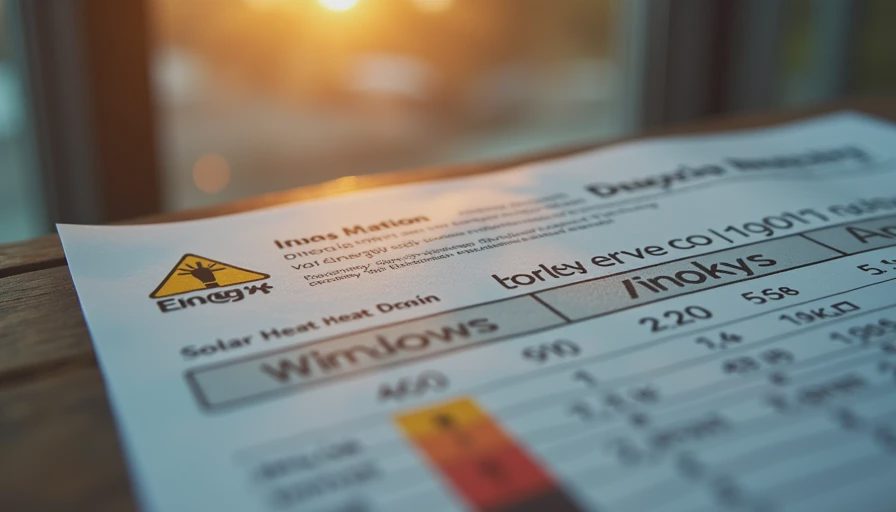
Ask for the NFRC label or manufacturer performance sheet for the exact window and glass package. Don't rely on a brochure showing the best possible rating for a different size or configuration. Window ratings can change with frame material, operating style, glass coatings, and dimensions.
Start with U-factor. For a cold-climate replacement, look for a number near 0.30 or lower. Then check SHGC based on the window's direction. Finally, look at air leakage, because a well-insulated window that leaks around the sash or frame won't feel like its advertised rating.
Ask whether the quote includes low-emissivity glass, argon gas, and warm-edge spacers. These features are common in efficient windows, but the exact package matters. Also ask whether the rating applies to the whole window rather than center-of-glass performance. Whole-window numbers are more useful for comparing products.
The installation quote needs the same scrutiny. A crew should remove or properly prepare the opening, install sill pan flashing where appropriate, set the unit plumb and square, insulate the gap without crushing the frame, and integrate the flashing with the wall's water-control layer. Expanding foam is not a substitute for flashing. Caulk is not a substitute for a level, square installation.
Is triple-pane glass worth the money?
Triple-pane windows usually provide a lower U-factor and a warmer interior surface. In a cold region, that can be worth it in a north-facing room, a large opening, or a house where the windows are near seating areas. Expect the upgrade to add roughly $100 to $300 per window, depending on brand, size, and configuration. A whole-house project can easily add $2,000 to $6,000.
But triple-pane glass is heavier. The frame must support it, and the installer must handle the unit correctly. If the existing opening has rot, poor flashing, or water damage, spending more on glass before fixing the opening is backwards. I've replaced expensive windows in houses where the sill was still taking on water. The homeowners bought better glass and kept the leak.
A sensible plan is to improve the worst openings first, especially those with failed seals, visible drafts, or condensation between panes. Then compare the installed price, not just the window price. A $900 window with a $300 installation may perform better long-term than a $700 window installed by someone rushing through a $150 labor allowance.
A practical buying checklist
Before signing a window contract, write down each opening's direction, approximate size, and main complaint. Cold glass points toward U-factor. Afternoon glare and overheating point toward SHGC or exterior shading. Water stains and drafts point toward installation and flashing.
Request the exact U-factor and SHGC in writing. Confirm the warranty covers both the glass seal and the frame. Ask who handles a failed unit and how long service usually takes. Get a separate line for trim repair, disposal, interior patching, and exterior capping so the final bill doesn't grow unexpectedly.
For a typical 15-window replacement, basic vinyl may run about $8,000 to $14,000 installed, while higher-end fiberglass or triple-pane packages can reach $15,000 to $25,000. Local labor and opening repairs move those numbers, but a detailed scope should explain the difference.
U-factor vs SHGC explained comes down to matching the rating to the job. Choose a lower U-factor when winter comfort and heat loss are the concern. Choose SHGC based on sunlight, orientation, and shading. Then hire a crew that treats flashing and square installation as part of the window, not an optional extra. I've been on that roof. Let me save you the trip.
Stay warm. Stay dry. — Dean




No notes on this sheet yet.